

SEO for Small Businesses: The Honest Guide
I run a digital agency, and I talk to small business owners every week — plumbers in Texas, dental clinics in Florida, boutique shops in New Jersey. Almost all of them ask me some version of the same question: “Is SEO actually worth it for a business my size, or is it just something agencies say to sell retainers?”
Fair question. And I’ll give you the straight answer up front: for a small business, SEO is one of the best marketing channels you can invest in — and it’s also one of the most oversold by the people selling it.
This guide is my attempt to tell you the whole truth — what small-business SEO actually is, what it costs you in time and money, how long it takes, when you should do it yourself, and how to spot the providers who will waste your money. No guarantees, no magic formulas. Just what I’ve learned since 2019 doing this work.
What Small-Business SEO Actually Is (and Isn’t)
Let’s start by clearing up the biggest misconception: SEO isn’t a trick you play on Google, a secret list of keywords, or something you “do once” and forget about. It’s the ongoing work of making your business easy to find, easy to understand, and easy to trust — for both Google and the real humans behind the searches. When someone in your city searches “emergency plumber near me” or “best family dentist in Austin,” SEO is what determines whether your business shows up or your competitor’s does.
In practice that means a few concrete things: claiming and optimizing your Google Business Profile. Making sure your website clearly says what you do and where you do it. Getting listed correctly in online directories. Earning genuine reviews from real customers. Publishing content that answers the questions your customers actually ask.
What it won’t do: guarantee page-one rankings, work as a one-time project, or deliver overnight. And despite what some agencies will tell you, it isn’t something only big companies with big budgets can benefit from. In some ways, small businesses have an advantage — you’re closer to your customers, you can move faster, and local search rewards exactly that kind of specificity.
One more thing it isn’t: free. Even if you do it yourself, it costs you time. Anyone who tells you SEO is “free traffic” is selling you something. It’s cheaper than ads over the long run in most cases, but it’s never free.
Why Google and Local Search Matter for Your Business
Think about the last time you needed something local — a car repair shop, a restaurant, a locksmith. What did you do? You probably pulled out your phone and searched. Your customers do exactly the same thing.
A large share of local searches lead to a store visit or a phone call within a day. I won’t quote you a precise percentage here because the exact numbers vary by study and industry, and I’d rather be vague than wrong. But the pattern is undeniable: when people need a local service, Google is where the decision starts.
There’s a second shift happening right now that small business owners should know about. People are increasingly getting answers directly from AI assistants — ChatGPT, Google’s AI Overviews, voice search — instead of clicking through a list of blue links. This doesn’t kill SEO; it changes what “being found” looks like. The businesses that show up in AI answers tend to be the ones with consistent, trustworthy information everywhere: a complete website, an active Google Business Profile, real reviews, mentions on other reputable sites. In other words, the same fundamentals I’m about to walk you through — as part of a broader digital marketing strategy. The details of exactly how AI systems pick which businesses to mention? Nobody outside those companies knows for sure — and anyone who claims they have it figured out is guessing.
So the core bet of small-business SEO is simple: be the business Google (and increasingly, AI assistants) can confidently recommend. That confidence comes from consistency, completeness, and real-world reputation — not tricks.
The Core Components of Small Business SEO
Small-business SEO breaks down into five pieces. You don’t need to master all five on day one, but you should understand what each one does.
Your Google Business Profile
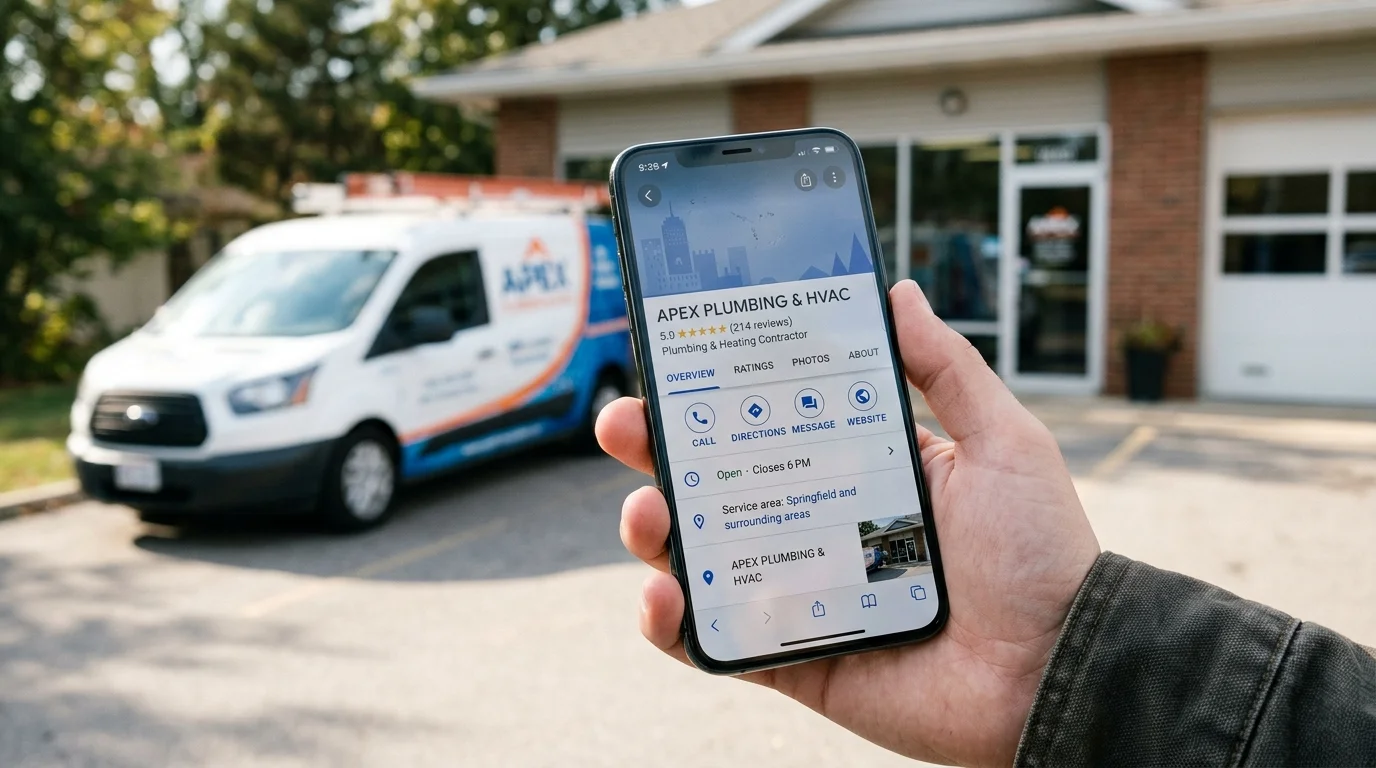
This is the single highest-leverage thing on this list, and it’s free. Your Google Business Profile is the listing that shows up in Google Maps and in the local results when someone searches for what you do. It shows your hours, your phone number, your reviews, your photos, and a button to call you or get directions.
If you haven’t claimed yours yet, stop reading and go do it now — it takes about fifteen minutes. Then fill out every field: services, business hours, photos of your actual work (not stock photos), and a real business description. Add new photos regularly. Post updates when you have news or offers. And respond to every review, including the bad ones — especially the bad ones. A thoughtful, professional reply to a negative review does more for your reputation than ten five-star reviews with no replies.
I see so many businesses with unclaimed or half-finished profiles, and it genuinely pains me. This is the closest thing to a free storefront that exists, and most of your competitors are ignoring it.
Your Website’s On-Page SEO

Your website needs to clearly tell Google — and visitors — what you do, where you do it, and why someone should choose you. The fundamentals:
- One clear H1 per page that says what the page is about. Not five headings competing with each other.
- Title tags and meta descriptions written for humans first. The title tag is what shows up as the clickable headline in Google results — make it something a real person would want to click.
- Location signals. If you serve Dallas, your site should say so naturally — in headings, in the footer, on a dedicated service-area page if it makes sense. Don’t stuff “Dallas plumber” into every sentence; write like a human who happens to be in Dallas.
- Fast loading and mobile-friendly. Most of your customers will find you on a phone. If your site takes forever to load or looks broken on mobile, they’ll hit the back button and call whoever loaded faster. Google notices that too.
- Clear calls to action. A phone number that’s easy to tap. A contact form that actually works. A “book now” button that goes somewhere real. SEO brings people to the door; your site has to let them in.
Citations and NAP Consistency
“Citations” is the industry word for your business being listed on other websites — Yelp, Yellow Pages, industry directories, your local chamber of commerce site. “NAP” stands for Name, Address, Phone number.
Here’s the part that matters: your NAP needs to match everywhere. If your website says “123 Main St, Suite 4” but Yelp says “123 Main Street #4” and some old directory still lists your previous phone number, Google gets confused about which business is the real one — and confused search engines don’t recommend businesses confidently.
You don’t need to be on five hundred directories. Get the important ones right and consistent: Google, Bing, Apple Maps, Yelp, Facebook, and the directories that matter in your specific industry (Avvo for lawyers, Healthgrades for medical, Houzz for contractors, and so on). Fix the wrong ones. Nobody enjoys this work, but I’ve seen it move rankings for clients more than once.
Reviews

Reviews are two things at once: a visibility factor and a conversion factor. Review quantity and recency feed into how confidently Google shows your business — and your potential customers read them before they ever call you. In our experience, a business with 4.8 stars and two hundred recent reviews will usually win the call over a business with no reviews, even if the second one is better at the actual work. Replying to every review (including the bad ones) won’t directly move your rankings, but it absolutely moves the humans reading them — and that’s what turns searches into calls.
The right way to get reviews: ask. After a job well done, send a short message with a direct link to your Google review page. Make it easy. Most happy customers simply never think to leave a review unless someone asks.
What not to do: don’t buy reviews, don’t trade them, don’t have your cousin leave five from different accounts. Google is better at detecting this than most people think, and getting caught can get your profile suspended. It’s not worth it. Slow, real reviews beat fast, fake ones every time.
Content That Answers Real Questions
You don’t need a blog with fifty articles. But a small business website with a handful of genuinely useful pages will outperform a thin five-page brochure site.
Think about what your customers ask you on the phone. “How much does it cost to…?” “Do you serve [neighborhood]?” “What’s the difference between X and Y?” Each of those is a page or a section waiting to happen. Write the way you talk to customers — direct, specific, honest about what you can and can’t do.
One caveat: content takes time to work. A page you publish today might take months to start bringing in traffic. That’s normal. The businesses that win at this are the ones that publish consistently and patiently, not the ones looking for a quick win.
A Simple 30-Day SEO Plan for a Small Business
If all of the above feels like a lot, here’s where to start — in priority order, one week at a time.
Week 1: Fix the basics
- Make sure your website is indexable and your key pages load properly.
- Claim your Google Business Profile (or review it if it’s already claimed) and start the verification process.
- Check that your business name, address, phone number, and hours are correct everywhere they appear.
Week 2: Improve your key pages
- List your main services and the areas you genuinely serve.
- Rewrite your page titles, headings, and service descriptions so a real person understands them.
- Fix obvious mobile and speed issues — test your site on your own phone.
Week 3: Build trust
- Set up a simple routine for asking happy customers for Google reviews.
- Fix your listings on the important directories (Yelp, Bing, Apple Maps, Facebook).
- Add one page answering the question customers ask you most.
Week 4: Measure and prioritize
- Look at Google Search Console: impressions, clicks, and which queries bring people in.
- Count actual calls, form submissions, and direction requests — not just rankings.
- Pick the single highest-impact improvement for next month instead of changing things at random.
Do this every month and you’ll be ahead of most of your competitors within half a year — because most of them won’t do it at all.
How Long Does This Actually Take?

This is the question I get asked most, and the answer nobody likes: it depends. I’ll give you honest ranges instead of a fake precise number.
For a local business in a moderately competitive market, here are rough planning ranges — not promises. Within two to three months of consistent work, you’ll typically see early movement: more impressions, better rankings for some terms, more profile views. But phone calls and form fills — actual leads — usually take four to six months to become steady, and longer in competitive markets (think personal injury lawyers in Los Angeles, or HVAC in Houston). The work never really stops because your competitors aren’t stopping either.
What affects the timeline: how competitive your market is, how established your online presence already is, whether your website needs major fixes first, and how consistently the work gets done. A brand-new business with no reviews and a broken website will take longer than an established business with fifty reviews that just needs its profile optimized and some content added.
Anyone who promises you page-one rankings in 30 days is either lying or planning to do something that will get you penalized. Good SEO is slow at the start and builds on itself — the pages and links you earn in month one keep working in month twelve. If someone can’t explain that to you patiently, don’t hire them.
(I wrote a deeper breakdown of SEO timelines on the blog — read how long SEO takes if you want the full picture.)
Should You Do It Yourself or Hire Someone?
Straight answer: it depends on three things — your time, your budget, and how competitive your market is.
DIY makes sense when: you’re just starting out, your market isn’t brutally competitive, and you have a few hours a week to spend. Claiming your Google Business Profile, fixing your NAP citations, asking for reviews, and publishing a few helpful pages are all things a motivated owner can do. The fundamentals I described above will get you surprisingly far.
Hiring makes sense when: your time is better spent running your business, your market is competitive enough that DIY won’t cut it, or you’ve tried the basics and plateaued. A good provider brings experience across dozens of businesses, tools you won’t buy yourself, and — frankly — the discipline to do the boring work consistently.
The hybrid that works for most small businesses: do the basics yourself (profile, reviews, asking customers), and hire help for the technical and strategic parts (website fixes, content strategy, competitive analysis). You stay involved enough to know what’s happening, without spending your evenings learning schema markup.
What I’d avoid: hiring the cheapest option you can find. SEO at rock-bottom prices almost always means automated, low-quality work — spammy directory submissions, thin content, link schemes. It can actively hurt you. If your budget is genuinely tight, you’re better off doing the fundamentals yourself for six months than paying someone a tiny retainer to do damage.
How to Vet an SEO Provider (and the Red Flags I Watch For)
If you decide to hire, here’s how I’d evaluate providers — including, frankly, how I’d want you to evaluate us.
Good signs:
- They ask about your business goals before talking about tactics. If the first conversation is about keywords instead of revenue, walk away.
- They explain what they’ll actually do, in terms you understand. Vague promises of “optimization” mean nothing.
- They show you real reporting — not just ranking screenshots, but traffic, calls, and what changed because of their work.
- They’re honest about timelines. Anyone who says “it depends” and explains why is more trustworthy than anyone who promises page one by March.
- They have real experience with businesses like yours, and they can talk about it specifically.
Red flags:
- Guaranteed rankings. Nobody can guarantee Google rankings — not us, not anyone. Google says so explicitly. A guarantee is either a lie or a trick (like guaranteeing you’ll rank for a keyword nobody searches).
- Secret methods. Real SEO isn’t secret. If they can’t explain what they do, it’s because what they do wouldn’t survive explanation.
- Suspiciously cheap. Quality SEO takes real hours from real people. If someone offers you “full SEO” for a price that couldn’t possibly cover the labor, the labor isn’t happening — automation is.
- No reporting, or reports you can’t understand. If you can’t tell what you’re paying for, you’re paying for nothing.
- They own your assets. Your Google Business Profile, your domain, your website logins — these are yours. Any provider who sets things up under their own accounts and won’t hand over access is holding you hostage.
- Long lock-in contracts with no performance clauses. A month-to-month or short-term arrangement with clear deliverables is the fair structure. Anyone demanding a year upfront before showing results is selling confidence they haven’t earned.
Ask for references. Ask what happens if you cancel. Ask who exactly will be doing the work. The good providers welcome these questions; the bad ones get uncomfortable. If you’d like to run through this checklist with us, get in touch — no pitch, just straight answers.
Frequently Asked Questions
For most local small businesses, legitimate SEO runs $750–$1,250 per month — that’s the range we typically see for the core work: profile optimization, citations, reviews management, and steady content. (Your market and competition move this up or down.) Basic local work in a non-competitive market can come in lower; competitive markets with serious content needs go higher. One-time projects (like a website SEO overhaul) are priced by scope. What matters more than the number is what you’re getting: ask for the specific deliverables, the reporting you’ll receive, and how success will be measured. And remember the rule from above — if the price seems too good to be true, it is. (I’m publishing a full pricing breakdown soon — see “What’s Coming Next” below.)
Yes — the fundamentals are genuinely doable. Claim your Google Business Profile, keep your business information consistent everywhere, ask happy customers for reviews, and make sure your website clearly describes your services and service area. That covers a large portion of what matters for local businesses. Where DIY usually hits a wall: technical website issues, competitive keyword strategy, and content production at scale. Start DIY, and bring in help when you plateau or when your time becomes more valuable elsewhere.
They do different jobs. Google Ads puts you at the top immediately — you pay per click, and the moment you stop paying, you disappear. SEO builds visibility that keeps working after the work is done, but it takes months. For most small businesses, the practical answer is: ads for immediate leads while SEO builds in the background, then adjust the mix as organic traffic grows. If your budget only allows one, pick based on urgency — need calls this month? Ads. Building for the next two years? SEO. (We manage Google Ads too, so I’m not telling you this to steer you away from ads — they have their place.)
Watch business metrics, not vanity metrics. Rankings for a handful of keywords are nice, but what matters is: Are you getting more calls? More contact form submissions? More direction requests on your Google Business Profile? A good provider reports on traffic, conversions, and what changed — not just a screenshot of a ranking tracker. Set up call tracking or at least ask every new customer how they found you. That simple question is the most underrated measurement tool in small-business marketing.
No — but it’s changing what “showing up” means. People increasingly get direct answers instead of clicking links, which means fewer clicks overall for some queries. The businesses that get mentioned in AI answers are the ones with strong fundamentals: complete profiles, real reviews, consistent information, and genuinely useful content. Nobody outside Google and OpenAI knows exactly how these systems choose businesses, so be skeptical of anyone selling “AI SEO” as a solved science. The practical move is the same one SEO has always rewarded: be the most credible, complete, findable answer in your market.
There’s no magic number, and more isn’t automatically better if they’re old or look fake. What matters: a steady stream of recent, genuine reviews, and your responses to them. A business with 40 recent reviews can often outperform one with 200 reviews from three years ago. Focus on consistency — a few new reviews every month — rather than chasing a total. And respond to all of them; it shows readers you’re an active, engaged business, and that’s what turns profile views into calls.
For the work itself, location doesn’t matter much — SEO is done on computers, and a good provider in another state (or another country) can do excellent work. What matters is communication and understanding of your market. Can they get on a call during your business hours? Do they understand your local competition? We’ve worked with US small businesses since 2019 from our base in Pakistan — dozens of clients on monthly, hourly, and project arrangements over the years — and the model works because we’re available when clients need us and we do the homework on each market. Judge providers on responsiveness and results, not zip codes.
You won’t vanish overnight, but you’ll gradually slide. Competitors who keep working will pass you — they’ll accumulate more reviews, fresher content, and stronger signals while yours go stale. Think of it like fitness: you don’t lose everything the week you stop, but a year of inactivity shows. The good news is that the foundation you build (your profile, your reviews, your content) keeps some value even if you pause active work. SEO is one of the few marketing channels where past effort keeps paying — it just pays less over time without maintenance.
What’s Coming Next
This pillar is the starting point. Over the coming weeks, I’ll be publishing deeper guides on each piece:
- The Google Business Profile Optimization Guide — every field, every feature, and the weekly routine that keeps your profile working.
- Local Citations and NAP Consistency — where to list your business, how to find and fix wrong listings, and which directories actually matter.
- How Much Does Small Business SEO Cost? — honest pricing breakdowns by market type, what drives the price up or down, and how to budget for it.
- SEO vs. Google Ads for Small Budgets — a detailed comparison for businesses that can only afford one, including when to switch from one to the other.
- Small Business Content Strategy & Keyword Research — what to write, which keywords to target, and how to plan content without a marketing team.
If there’s a topic I missed that you’d want covered, that’s useful feedback — the best content ideas come from real questions. About our team.